August 11, 2026
OCR Engine Benchmark: Gemini vs Tesseract (Measured CER)
Original 12-image benchmark of Google Gemini vs Tesseract 5 LSTM with published corpus, ground truth, and per-category character error rates.
By Elango P · About this site
This is a measured head-to-head of the two engines behind OCR Text Extractor: Google Gemini (the site’s default AI OCR path) and Tesseract 5 LSTM (the classical engine the browser fallback is built on). We published the corpus, the ground-truth text, the raw outputs, and the character error rates — not marketing claims.
Run date: 11 August 2026 Benchmark ID: imgtotext-ocr-bench-v1 Raw data: /benchmark/results.json · /benchmark/ground_truth.json · corpus images Re-run script: python3 scripts/run_ocr_benchmark.py
Headline numbers
Over 12 synthetic English images across six categories:
| Engine | Mean character error rate (CER) |
|---|---|
| Google Gemini | 3.05% |
| Tesseract 5.5.0 (OEM 1 / LSTM, PSM 3) | 19.75% |
CER is edit distance divided by ground-truth length after a documented whitespace normalization. Lower is better. These are not “accuracy %” marketing scores, and they are not industry-wide averages — they describe this fixed corpus only.
Why this page exists
Most OCR comparison articles hand-wave. This one does not. If you never use the converter on this site, the methodology and the failure cases below are still usable: you can download the PNGs, re-run either engine, and check whether our numbers still hold.
That is the point. Converter sites get rejected as low-value when every page only explains how to click Upload. Original measurements are something reviewers (and readers) can verify.
Methodology
Corpus
Twelve PNGs, two per category, generated with a fixed seed (20260811) so the set is reproducible:
| Category | What it stresses |
|---|---|
clean_print | High-contrast printed body text (control) |
thermal_receipt | Narrow mono layout, gray paper, soft blur, vignette |
dark_mode_screenshot | Dark UI, light mono text, window chrome |
skewed_scan | ~7.5° rotation on a desk-colored background |
low_light_photo | Uneven lighting, noise, heavy JPEG round-trip |
handwriting_sim | Italic serif with per-glyph jitter on ruled paper |
Honest limit on handwriting: handwriting_sim is not real penmanship. It is DejaVu Serif Italic with random offsets. It stresses irregular spacing; it does not claim CER for human handwriting. Real handwriting remains harder than this category suggests.
All samples are synthetic. No customer documents were used.
Engines and prompts
- Gemini: same extraction prompt and generation settings as `app/api/ocr/route.js` on this site (
temperature: 0.1, English language hint, “extract only / no commentary”). Uses the same Google Gemini model as the live AI OCR path. Images sent as PNG base64. - Tesseract: system
tesseract 5.5.0,-l eng --oem 1 --psm 3 -c user_defined_dpi=300. OEM 1 matches the site’sOEM.LSTM_ONLYintent.
Important difference vs the live tool: the site’s browser path runs extra preprocessing (upscale, contrast, thresholding, optional crop) before Tesseract.js. This benchmark feeds each engine the raw PNG so the comparison is about recognition under identical pixels, not about our preprocessor. Treat the Tesseract column as a lower bound on what classical OCR can do here without help.
Metric
`` CER = levenshtein(normalize(hypothesis), normalize(reference)) / len(normalize(reference)) ``
normalize collapses any whitespace run to a single space and strips ends. That stops newline differences from dominating the score when the characters are otherwise correct.
Results by category
Mean CER within each two-image category:
| Category | Tesseract CER | Gemini CER |
|---|---|---|
| Clean print | 0.00% | 0.00% |
| Low-light photo | 0.42% | 0.42% |
| Handwriting (simulated) | 1.82% | 0.00% |
| Dark-mode screenshot | 14.77% | 13.88% |
| Thermal receipt | 36.62% | 4.01% |
| Skewed scan | 64.87% | 0.00% |
Pattern in plain language:
- On clean print and our low-light set, both engines were essentially tied.
- On thermal receipts and skewed paper, Gemini pulled far ahead.
- On dark screenshots, both struggled for similar reasons (UI chrome), not because one model “failed OCR.”
Failure cases worth studying
1. Skewed permission slip — Tesseract returned nothing
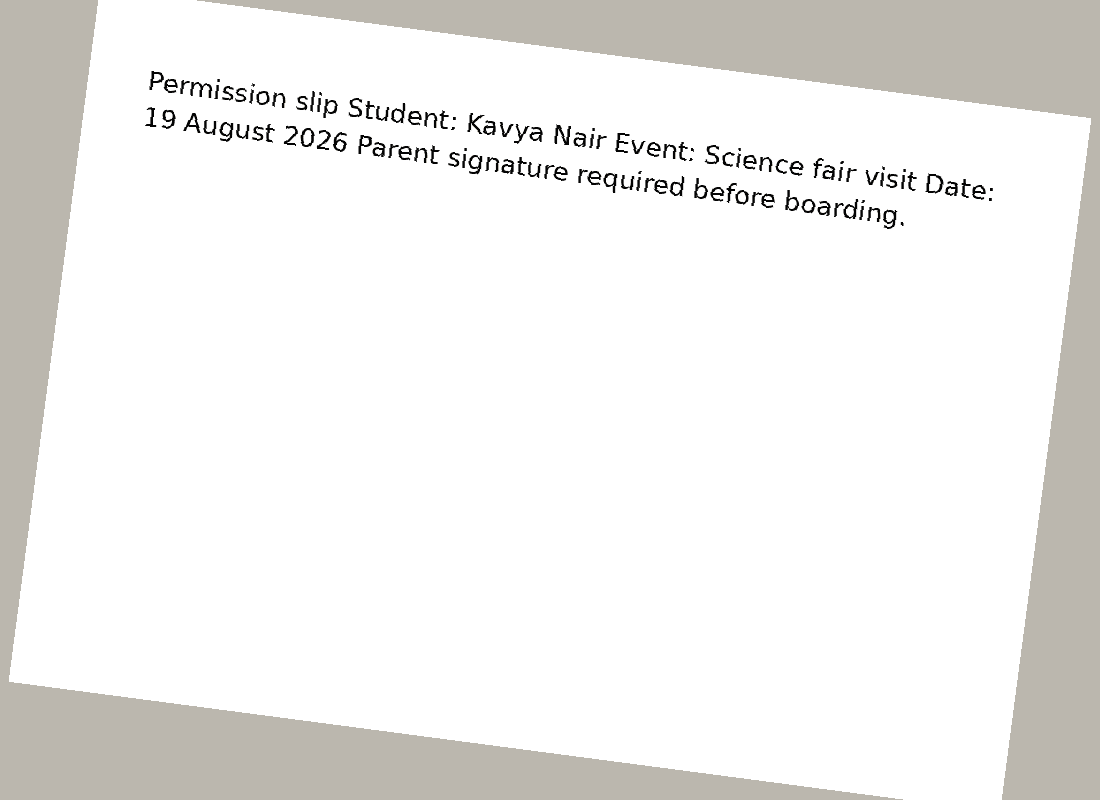
Ground truth (excerpt): Permission slip for Kavya Nair / Science fair visit / 19 August 2026.
| Engine | CER | What happened |
|---|---|---|
| Tesseract | 100% | Empty output |
| Gemini | 0% | Full text recovered |
A 7.5° deskew is enough to make an unassisted classical pass collapse on this sample. Gemini still read it. In the live product, the browser fallback’s rotate/preprocess path exists precisely because cases like this are common; the AI path still wins when the pixels arrive already tilted.
2. Thermal receipt — amounts went missing
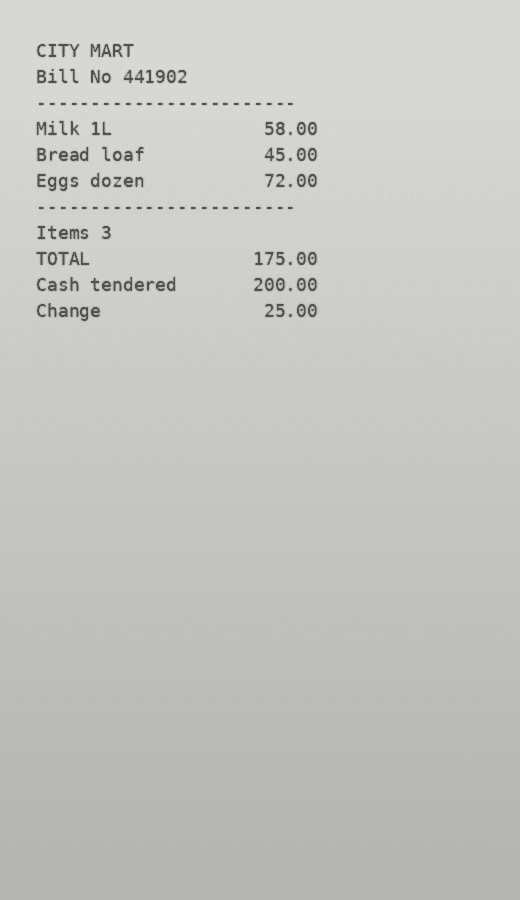
Ground truth includes: Milk 1L 58.00, Bread loaf 45.00, Eggs dozen 72.00, TOTAL 175.00.
| Engine | CER | What happened |
|---|---|---|
| Tesseract | 51.41% | Kept item names; dropped or detached most money figures (175. / 200. / 25. stranded) |
| Gemini | 4.52% | Kept line items and totals; separator dashes differed from ground truth |
If you OCR receipts for bookkeeping, proofread every figure regardless of engine. Money is where layout stress and thin thermal type hurt classical OCR most. See also Receipt to Text.
3. Dark terminal screenshot — chrome polluted both outputs
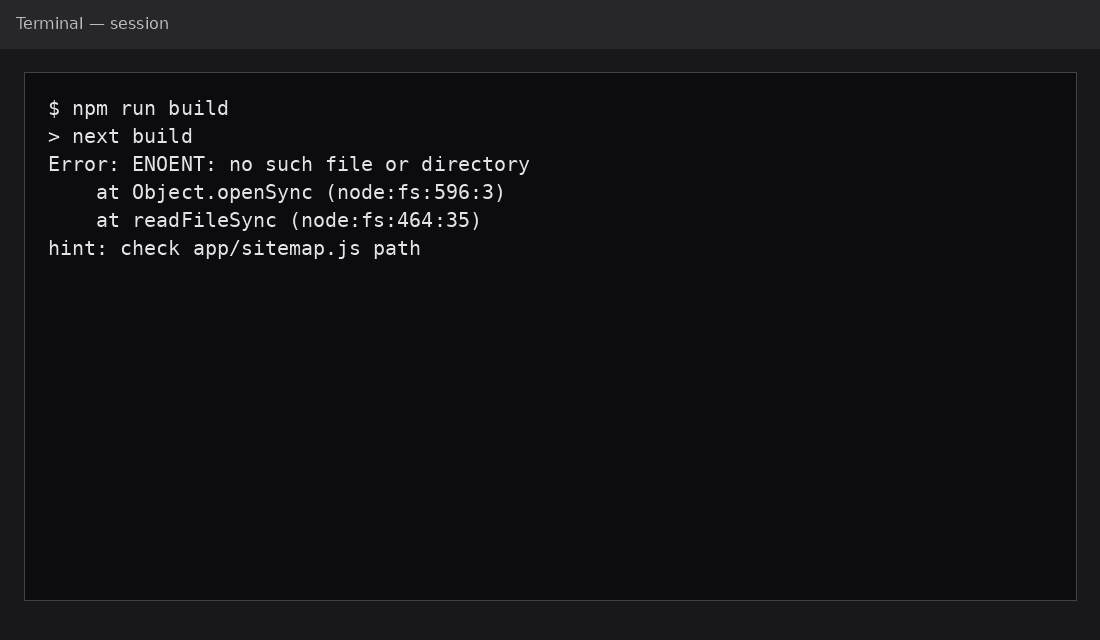
Ground truth was only the terminal body. Both engines also transcribed the window title Terminal — session, which was never in the reference string. That alone raises CER even when the useful text is mostly right.
Tesseract additionally read npm as mpm and inserted spaces inside node:fs. Gemini kept npm and the node:fs paths intact, but still paid the chrome penalty.
Practical fix: crop to the content region before upload — the same advice as on Screenshot to Text. Clean Mode on the browser path tries to drop edge chrome; it cannot invent a crop you should have made.
What this does not prove
- It does not prove Gemini always beats Tesseract. Clean print was a tie at 0% CER.
- It does not measure Hindi, Tamil, Arabic, tables, or multi-column magazine layouts.
- It does not measure the site’s Tesseract.js preprocessor — only raw recognition.
- It does not measure human handwriting.
- Twelve images are enough to be honest and reproducible; they are not enough to be a leaderboard.
If you need a larger set, fork the corpus under /benchmark/, add labeled images, and re-run the script. We will revise this article when the corpus grows — and we will set dateModified only when the numbers or method actually change.
How this maps to the product
On imgtotext.in the default path is AI OCR (Gemini) with a daily cap of 10 requests per IP address. When that path is unavailable, rate-limited, or you choose Local OCR only, recognition continues in the browser with Tesseract.js. The hybrid exists because the categories above do not share one winner: classical OCR is fine for clean print once the image is prepared; AI OCR earns its keep on skew, thermal layout, and ambiguous scenes.
For the conceptual comparison without numbers, see AI OCR vs Traditional OCR. For practical capture advice, see How to Improve OCR Results on Low-Quality Images and OCR Accuracy and Limitations.
Reproduce it yourself
- Clone the site repo (or download the PNGs from
/benchmark/corpus/). - Ensure
tesseractis on yourPATHandGOOGLE_GENERATIVE_AI_API_KEYis set. - Run
python3 scripts/run_ocr_benchmark.py. - Diff your new
public/benchmark/results.jsonagainst the published file.
If your CERs diverge, say so — that is how a real benchmark ages, not how a brochure ages.
FAQ
Why character error rate instead of word accuracy? CER is standard for OCR research, sensitive to single-digit money errors, and comparable across short receipts and longer paragraphs.
Why synthetic images? So we can publish ground truth and the pixels without redacting anyone’s private documents. Synthetic does not mean “easy” — the thermal and skew categories were hard enough to separate the engines.
Will you add real camera photos later? Yes, when we have a rights-cleared set with typed ground truth. Until then we will not invent field-photo statistics.
Try free image to text OCR
Upload an image to extract editable text — AI OCR runs first (images go to Google Gemini via our server); browser OCR is the fallback. No signup required.
Extract text from images